Reviewed by Angela Mutiso
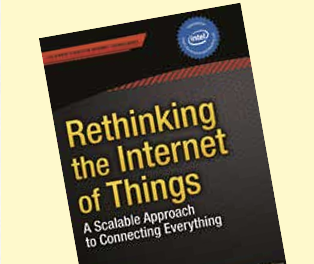
Title: Rethinking the Internet of Things: A Scalable Approach to Connecting Everything.
Author: Francis daCosta (with Byron Henderson)
Category: Information Technology
Publisher: Apress
Here’s the problem. The internet we use today was never designed for billions of tiny sensors, valves, and machines. This book explains what to do about it.
Francis DaCosta explores an important but often overlooked idea: the Internet of Things is not simply a larger or faster version of today’s internet. Rather than extending familiar web logic, it requires a different way of thinking about communication.
Across eight tightly argued chapters, the book builds from this premise and guides readers toward a new framework for how connected devices should interact as their numbers scale into the billions. It notes that the Internet of Things requires a new solution. The architecture of the original Internet was created long before communicating with billions of very simple devices, such as sensors and appliances, was ever envisioned.
The first chapter, titled “It’s Different Out Here,” sets the stage. DaCosta encourages readers to look beyond familiar screens and consider where most connected devices are: in fields, factories, pipes, roads, and machines. These devices don’t browse, search, or consume content. Instead, they sense, measure, and act. DaCosta uses subtle humour to point out that treating a soil sensor or a pressure valve like a laptop is a mistake the industry often makes. This chapter is important because it challenges common assumptions and helps readers see connectivity in a new way.
Chapter 2, “Anatomy of the Internet of Things,” deepens that argument. In this chapter, daCosta breaks IoT down into its main parts: end devices, communication layers, data handling, and decision systems. Instead of making things more complicated, he shows where complexity already exists and explains that much of it comes from old habits rather than real needs. In a field full of buzzwords, this chapter stands out by treating IoT as a whole system and showing how inefficiency often starts before devices are even used.
Chapter 3, “On the Edge,” pushes the critique further by examining where most IoT devices actually operate. These sensors and actuators are small, cheap, and low-power, but they are often expected to use complex internet protocols designed for desktop computers. DaCosta argues, both technically and simply, that forcing these small devices to use full protocol stacks raises costs, uses more energy, and tries to solve problems they don’t have. He compares this to asking a bicycle to do a freight vehicle’s job. As edge computing becomes more important, this chapter feels especially relevant.
Running quietly through these chapters is a progressively unsettling idea, sometimes framed in the book as “humans need not apply.” DaCosta is not arguing for the removal of people from the internet, but for a change in its centre of gravity. The traditional internet is built around human attention, screens, clicks, and interaction. The IoT internet he describes is largely machine-to-machine, autonomous, and indifferent to whether a human is watching.
Signals are exchanged and decisions triggered without pause for interpretation. The implication is subtle though firm: unless humans understand this new logic and position themselves where design, interpretation, and oversight occur, they risk becoming peripheral to systems they once controlled.
From there, the book builds its alternative vision. Chapter 4, “Building a Web of Things,” leads into Chapter 5, “Small Data, Big Data, and Human Interaction,” and introduces the idea of “chirps” – small, efficient machine signals that make up most IoT communication. Humans do not sit in the middle of these exchanges; they appear later, when patterns are aggregated, and meaning is extracted.
Chapter 6, “Architecture for the Frontier,” offers the book’s most concrete proposal: an alternative structure built around end devices, propagator nodes, and integrator functions, designed to coexist with the existing internet rather than replace it. Chapter 7, “Examples and Applications,” then grounds these ideas in real-world settings, while Chapter 8, “Pathways to the Internet of Things,” closes by looking ahead and offering direction rather than prediction.
What gives the book its lasting weight is its perspective. Francis daCosta writes from experience in networking and distributed systems, not from fascination with novelty. He understands the internet as infrastructure, with limits, trade-offs, and consequences.
More than a decade on, as automation and AI increasingly shape decision-making systems, Rethinking the Internet of Things reads less like speculation and more like early instruction. It reminds us that the future internet will not wait for human comfort. This book reframes how we think about the Internet of Things. It explains why IoT cannot rely on the same architecture as the traditional internet, introduces a new “chirp”- based approach to communication, and shows where IP falls short at massive scale. Readers learn the core building blocks of IoT and what it takes to design networks that unlock its real potential rather than constrain it.
It is written for decision-makers and builders shaping the future of connected systems: executives, architects, standards leaders, and developers, as well as organisations looking to adapt existing products into intelligent devices without incurring unnecessary cost or complexity. This book serves as a blueprint for engineers and researchers to design future-proof IoT systems that can handle billions of connected devices without collapsing under the weight of inefficiency. Above all, it speaks to anyone who wants to understand how the internet must grow, and how to stay relevant as that change accelerates.
Most people will try to build the future the old way. That won’t work. This book shows another way.
This book is available online and in leading bookshops.